

LimeSurvey - Easy online survey tool
  • Solutions
    • Solutions sub
  • Templates
    • Templates sub
  • Products
    • Polls
    • Questionnaires
    • Votes
    • Forms
    • Surveys
  • Resources
    • Blog
    • Overview
    • Help center
    • Forums
    • FAQ
    • Support
    • Contact
    • Partners
  • Pricing
Contact sales Login Get started - free
LimeSurvey - Easy online survey tool
  • Solutions
    Popular solutions
    360 Degree Feedback Template

    360 degree feedback template

    Academic Event Feedback Survey Template

    Academic event feedback survey template

    All survey templates
    Your role
    Business manager
    Customer care specialist
    Event coordinator
    Marketing manager
    HR officer
    Physician/health worker
    Product manager
    Sports manager
    Student
    Teacher/educator
    Market researcher
    Survey types
    Business
    Corporate
    Customer
    Education
    Universities
    Events
    Healthcare
    Human resources
    Market research
    Marketing
    Nonprofit
    Product
    Sports
    Other
    Use cases
    Academic research
    Course evaluation
    Customer experience
    Customer satisfaction
    Employee experience
    Employee motivation
    Event planing
    Market segmentation
    Market research
    Patient satisfaction
    Product pricing
  • Templates
    Popular picks
    360 Degree Feedback Template

    360 degree feedback template

    Academic Event Feedback Survey Template

    Academic event feedback survey template

    All survey templates
    Survey templates
    Business templates
    Corporate templates
    Customer templates
    Educational templates
    Event templates
    Healthcare templates
    HR templates
    Market research templates
    Nonprofit templates
    Product templates
    Sports templates
    Other templates
    Our templates
    • Your roleYour role
      • Business manager
      • Customer care specialist
      • Event coordinator
      • HR officer
      • Marketing manager
      • Physician/health worker
      • Product manager
      • Student
      • Sports manager
      • Teacher/educator
    • Survey templatesSurvey templates
      • Business
        • Order forms
        • Shopping
        • Booking form
        • Startup
      • Corporate
        • Branded
        • Professional
      • Customer
        • Customer experience
        • Customer satisfaction
        • Customer feedback
        • Customer loyalty
        • Customer review
        • Customer service
      • Education
        • Course evaluation
        • Student
        • Teacher
        • Academic
        • Instructor evaluation
        • School
        • Student satisfaction
        • University
      • Event
        • Event experience
        • Event planning
        • Meeting planning
      • Healthcare
        • Patient satisfaction
        • Fitness
        • Alcohol assessment
        • Mental health assessment
        • Mental health
        • Patient consent
        • Patient
        • Personality test
      • Human resources
        • Employee experience
        • Employee motivation
        • 360 degree feedback
        • Application
        • Candidate assessment
        • Career finding
        • Employee questionnaire
        • Employee
        • Employee engagement
        • Employee satisfaction
        • Job satisfaction
        • Pulse
      • Market research
        • Market segmentation
        • Research
        • Concept testing
        • Online research
      • Marketing
        • Lead generation
        • Brand awareness
        • Advertisement effectiveness
        • Brand building
        • Brand perception
        • Brand
      • Nonprofit
        • Church
        • Human rights
        • Community
        • Political
      • Product
        • Product experience
        • Product pricing
        • Product evaluation
      • Sports
        • Fitness
        • Golf
      • Other
        • Anonymous forms
        • Opinion poll
        • Astrology
        • Checklist
        • Childcare
        • Complaint form
        • Contact form
        • Enquiry form
        • Evaluation form
        • Feedback form
        • Instructor evaluation
        • Motherhood
        • Pet
        • Poll
        • Privacy
        • Quiz
        • Registration form
        • Request form
        • Satisfaction
        • Self assessment
        • Sign up sheet
        • Social media
        • Training
    • Use casesUse cases
      • Academic research
      • Course evaluation
      • Customer experience
      • Customer satisfaction
      • Employee experience
      • Employee motivation
      • Event planing
      • Market segmentation
      • Market research
      • Patient satisfaction
      • Product pricing
  • Products
    Popular templates
    360 Degree Feedback Template

    360 degree feedback template

    Academic Event Feedback Survey Template

    Academic event feedback survey template

    All survey templates
    Products
    Polls
    Questionnaires
    Votes
    Forms
    Surveys
    Tools
    Margin of error calculator
    Sample size calculator
    CES calculator
    CSAT calculator
    NPS calculator
    eNPS calculator
    Statistical significance calculator
    Ab testing calculator
    MaxDiff sample size calculator
    Price optimization calculator
  • Resources
    • Blog
    • Overview
    • Help center
    • Forums
    • FAQ
    • Support
    • Contact
    • Partners
  • Pricing
English
EN
  • اَلْعَرَبِيَّةُ
  • Bokmål
  • Čeština
  • Dansk
  • Deutsch
  • Deutsch (Schweiz)
  • Español
  • Español (Mexico)
  • Français
  • हिन्दी
  • Hrvatski
  • Bahasa Indonesia
  • Italiano
  • 日本語
  • 한국어
  • Magyar
  • Bahasa Melayu
  • Монгол
  • Nederlands
  • Polski
  • Português
  • Português (Brasil)
  • Română
  • Русский
  • Slovenčina
  • Suomi
  • Svenska
  • Tagalog
  • ไทย
  • Türkçe
  • Українська
  • Tiếng việt
  • 简体中文(中国大陆)
  • 繁體中文 (台灣)
Contact sales Login Get started - free
Sign Up
Details
Category: Knowledge
22 September 2020
6 years ago

Survey design tips: how to create a good structure

3 Ways to Present Surveys to Your Audience One of the first things to decide when setting up a survey is the general design and presentation style for your questions and answers. In this context, you have to choose the format for displaying your survey. Essentially, this means you can either show your entire survey on one page, which is called scrolling survey design in the research world.  You can show your survey on multiple pages, i.e., one question per page, which is called paging survey design.   You can alternatively use a hybrid format offered exclusively by LimeSurvey that allows you to show one question group per page consisting of several questions, which we will call categorizing survey design. What seems like an easy decision at first will require some further consideration when looking closer at this design topic.  In light of the availability of different technical devices to take surveys on nowadays, such as desktop computers, tablets, or smartphones, formats may appear more advantageous on one device, yet more disadvantageous on another device. This adds extra complexity to the survey design. Researchers have been testing and evaluating this design question for years now by examining key metrics such as bounce rates, completion times, and rates, as well as item nonresponses. Insights indicate that surveys taken on desktop computers do not differ significantly for scrolling and paging designs with regard to completion and bounce rates. Merely, a tendency to skip certain questions was discovered for scrolling survey designs which could have had any number of reasons such as a mental overload, boredom, or other problems connected to survey fatigue.   Tips For Different Survey Design Formats One thing has to be stated clearly: there is no general best strategy that will apply to any type of survey. Ultimately, it comes down to the survey characteristics with regard to survey length in terms of time and number of questions, as well as technical equipment and connectivity. Nevertheless, scenarios can be created within which a certain design format may be more suitable than others due to the underlying survey conditions. This leads to the following tips for the usage of different survey design formats: In general, if your survey is short in terms of the time it requires to be completed, as well as a low number of questions, the recommendation will always be to use a scrolling design to keep the survey short, regardless of the device used. A paging or categorizing design will spread questions over several pages and require respondents to click on the next button as well as to adjust to the subsequent page(s), which prolongs a survey. This will almost always exhaust or lower respondents’ interest potentially resulting in lower completion or higher bounce rates. A paging design usually only makes sense if you have a long survey that is to be taken on either a desktop computer or a laptop, as these devices possess larger screens, as well as allow for faster cursor movements and clicks. This way, surveys can be completed in a more convenient manner when shifting from page to page. Obviously, the aforementioned paging design can also be replaced by a categorizing design which is the more elegant way as it groups question subtopics to facilitate respondents recognizing logical connections between questions. Because tablet and smartphone devices have smaller touchscreens, a categorizing design should be used with long surveys, as it would minimize the negative effects of both pure paging and scrolling designs. In the categorizing design, fewer clicks and new page loads are required than with the paging design, as well as less scrolling and information overload are present than with the scrolling design. The advantage of paging and categorizing design is perfectly clear: every time a respondent completes one or a few questions on a page and clicks the next button, this data is submitted and saved, even if the respondent drops out on the subsequent page. If a respondent completes the same amount of questions in a scrolling design and drops out without submitting, all that data is lost. In this scenario, paging and categorizing designs are more valuable as partial data may still deliver important insights.       Conclusion   All in all, we do, however, recommend that you try to avoid creating long surveys with many questions, as these will oftentimes lower completion rates and increase bounce rates due to survey fatigue. Try and split longer surveys by subtopics into multiple shorter surveys. This way, you will make sure to increase survey relevance to your target audience and earn more valuable data to analyze.In the end, it all comes down to how well you know your target audience. The more you find out about devices used and survey perseverance, the better you can suit your survey design to achieve the best results.  

Survey design tips: How to create a good structure

Table content

  • Facebook
  • Twitter
  • LinkedIn
  • Xing

3 Ways to Present Surveys to Your Audience

One of the first things to decide when setting up a survey is the general design and presentation style for your questions and answers. In this context, you have to choose the format for displaying your survey. Essentially, this means you can either show your entire survey on one page, which is called scrolling survey design in the research world. 
You can show your survey on multiple pages, i.e., one question per page, which is called paging survey design.
 
You can alternatively use a hybrid format offered exclusively by LimeSurvey that allows you to show one question group per page consisting of several questions, which we will call categorizing survey design.

What seems like an easy decision at first will require some further consideration when looking closer at this design topic.  In light of the availability of different technical devices to take surveys on nowadays, such as desktop computers, tablets, or smartphones, formats may appear more advantageous on one device, yet more disadvantageous on another device. This adds extra complexity to the survey design.

Researchers have been testing and evaluating this design question for years now by examining key metrics such as bounce rates, completion times, and rates, as well as item nonresponses. Insights indicate that surveys taken on desktop computers do not differ significantly for scrolling and paging designs with regard to completion and bounce rates. Merely, a tendency to skip certain questions was discovered for scrolling survey designs which could have had any number of reasons such as a mental overload, boredom, or other problems connected to survey fatigue.
 

Tips For Different Survey Design Formats

One thing has to be stated clearly: there is no general best strategy that will apply to any type of survey. Ultimately, it comes down to the survey characteristics with regard to survey length in terms of time and number of questions, as well as technical equipment and connectivity.

Nevertheless, scenarios can be created within which a certain design format may be more suitable than others due to the underlying survey conditions. This leads to the following tips for the usage of different survey design formats:


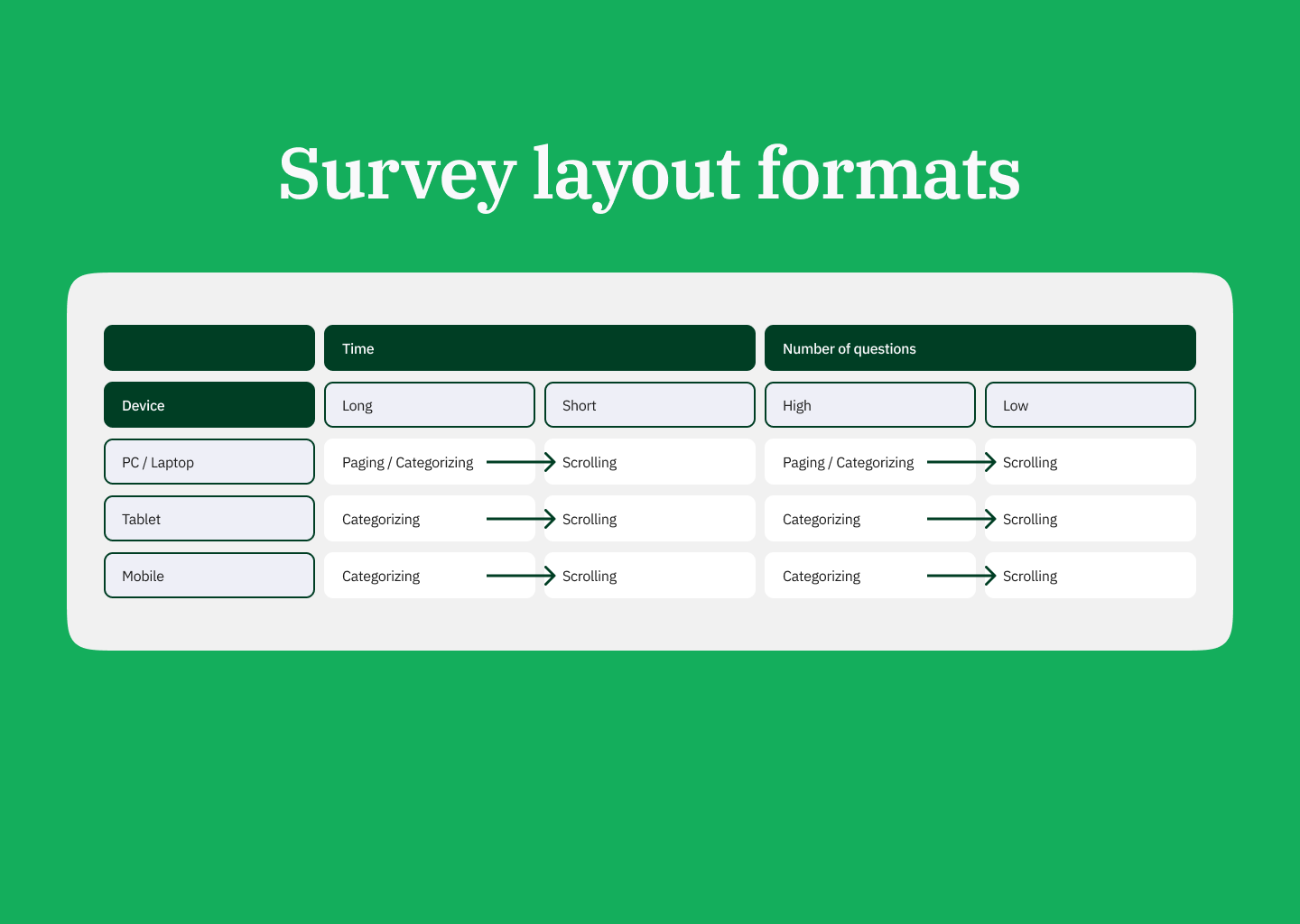
    • In general, if your survey is short in terms of the time it requires to be completed, as well as a low number of questions, the recommendation will always be to use a scrolling design to keep the survey short, regardless of the device used. A paging or categorizing design will spread questions over several pages and require respondents to click on the next button as well as to adjust to the subsequent page(s), which prolongs a survey. This will almost always exhaust or lower respondents’ interest potentially resulting in lower completion or higher bounce rates.

    • A paging design usually only makes sense if you have a long survey that is to be taken on either a desktop computer or a laptop, as these devices possess larger screens, as well as allow for faster cursor movements and clicks. This way, surveys can be completed in a more convenient manner when shifting from page to page.

    • Obviously, the aforementioned paging design can also be replaced by a categorizing design which is the more elegant way as it groups question subtopics to facilitate respondents recognizing logical connections between questions.

    • Because tablet and smartphone devices have smaller touchscreens, a categorizing design should be used with long surveys, as it would minimize the negative effects of both pure paging and scrolling designs. In the categorizing design, fewer clicks and new page loads are required than with the paging design, as well as less scrolling and information overload are present than with the scrolling design.

    • The advantage of paging and categorizing design is perfectly clear: every time a respondent completes one or a few questions on a page and clicks the next button, this data is submitted and saved, even if the respondent drops out on the subsequent page. If a respondent completes the same amount of questions in a scrolling design and drops out without submitting, all that data is lost. In this scenario, paging and categorizing designs are more valuable as partial data may still deliver important insights.
 

 Survey layout formats


Conclusion

 
All in all, we do, however, recommend that you try to avoid creating long surveys with many questions, as these will oftentimes lower completion rates and increase bounce rates due to survey fatigue. Try and split longer surveys by subtopics into multiple shorter surveys. This way, you will make sure to increase survey relevance to your target audience and earn more valuable data to analyze.

In the end, it all comes down to how well you know your target audience. The more you find out about devices used and survey perseverance, the better you can suit your survey design to achieve the best results.


 

You might also like

Colour psychology in survey design
Knowledge
8 years ago
Colour psychology in survey design
Colour psychology in survey design Have you ever wondered why you feel calm in a blue room,...
Design to Delivery: How Package Testing Enhances Your Online Survey Success
Knowledge
one year ago
Design to delivery: how package testing enhances your online survey success
Imagine you’re unboxing a long-awaited product that you've ordered online—a high-end gadget or a...
Everything You Need To Know About Synthetic Datasets
Knowledge
2 years ago
Everything you need to know about synthetic datasets
Researchers, businesses, and other individuals need data to make informed decisions. In almost all...

Legal

  • Terms & Conditions
  • Legal notice
  • Privacy notice
  • Cancellation

About Us

  • Blog
  • Newsletter
  • Careers

Open Source

  • Community
  • Forums
  • Developers
  • Translation
  • Survey types
  • Survey templates
  • Survey tools
  • Use cases
GDPR CCPA ISO 27001 is in progress
English
EN
  • اَلْعَرَبِيَّةُ
  • Bokmål
  • Čeština
  • Dansk
  • Deutsch
  • Deutsch (Schweiz)
  • Español
  • Español (Mexico)
  • Français
  • हिन्दी
  • Hrvatski
  • Bahasa Indonesia
  • Italiano
  • 日本語
  • 한국어
  • Magyar
  • Bahasa Melayu
  • Монгол
  • Nederlands
  • Polski
  • Português
  • Português (Brasil)
  • Română
  • Русский
  • Slovenčina
  • Suomi
  • Svenska
  • Tagalog
  • ไทย
  • Türkçe
  • Українська
  • Tiếng việt
  • 简体中文(中国大陆)
  • 繁體中文 (台灣)
Copyright © 2006-2026 LimeSurvey GmbH ⚓ Hamburg, Germany